Multiple-choice exams reward two things: what you know, and how you handle the paper. You cannot change the first overnight, but you can improve the second quickly. This article gives a routine you can practise on every question.
The five-step routine
Practise the same routine on every question until it becomes automatic. It keeps you calm and stops careless errors.
- Read the whole question. Watch for words like not, except, always and only. Many wrong answers come from missing one word.
- Cross out clearly wrong options. Removing even one option improves your odds a lot.
- Decide. If you know it, mark it. If you are unsure, think about the negative marking rule before guessing.
- Mark and move on. If a question is eating your time, mark it and return later.
- Review flagged questions in the time you saved.
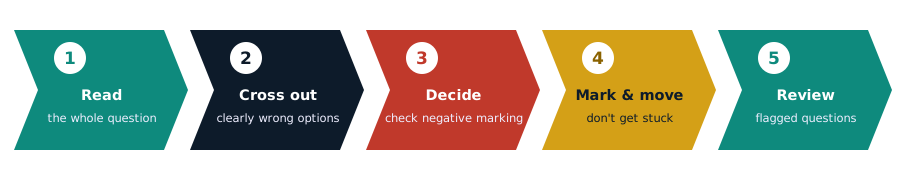
Figure: a five-step routine you can repeat on every multiple-choice question.
Time management
Divide the total time by the number of questions to find your average time per question, then keep a little time at the end for review. For example, a paper with 100 questions in 90 minutes gives well under a minute each. Do an easy first pass, answer what you are sure of, and use the remaining time for harder questions.
Negative marking: should you guess?
Many exams, including several Loksewa papers, deduct a fraction of a mark for each wrong answer. The exact deduction differs by exam, so always read the notice for your paper. Suppose a correct answer gives 1 mark, a wrong one takes away 0.2, and a question has four options.
| Situation | What happens on average | Reasonable choice |
|---|---|---|
| Pure guess among 4 options | Slightly positive: 0.25 × 1 − 0.75 × 0.2 = 0.10 | Small gain, but luck-based |
| You can eliminate 2 options | 0.5 × 1 − 0.5 × 0.2 = 0.40 | Usually worth answering |
| You have no idea and a larger penalty | Can be negative | Leave it blank |
The rule of thumb: guess when you can remove at least one or two options, and skip when you have no clue and the penalty is heavy. Check your own exam's marking before applying this.
Ways to find the answer when unsure
- Eliminate extremes. Options with "always" or "never" are often wrong in subjects with exceptions.
- Look for the odd one out or two options that are almost the same.
- Use other questions. A later question can quietly hint at an earlier one.
- Trust your first answer unless you find a clear reason to change it.
How to review after a mock test
The score matters less than what you learn from it. After each mock, sort every mistake into one of three groups: did not know, knew but misread, or ran out of time. Each needs a different fix: study the topic, slow down on reading, or practise speed. Keep a mistake notebook and look at it before the next test.
Use the practice and mock tests on MeroSir to build this routine, and treat the first few attempts as learning, not as a verdict on your ability.

Comments
Loading comments…