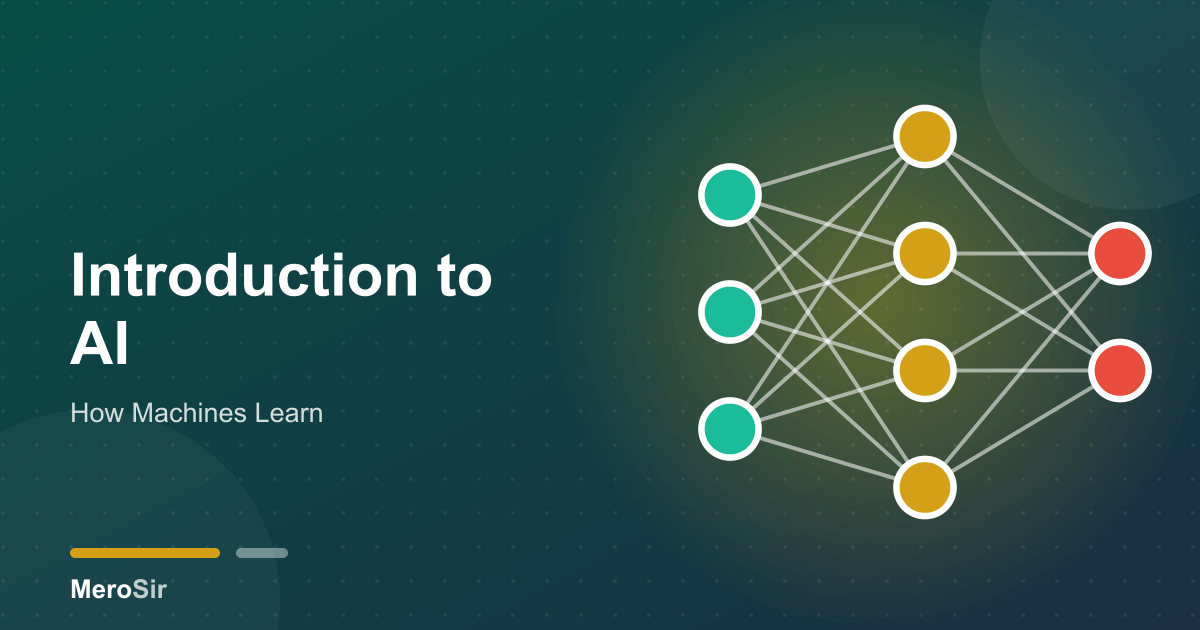
Artificial intelligence (AI) means computer systems that do things we normally think need human intelligence: understanding speech, recognising pictures, translating languages, recommending videos, or holding a conversation. AI is not magic and it is not a person. It is software that finds patterns in data.
Three words people mix up
| Term | Simple meaning | Example |
|---|---|---|
| Artificial intelligence | the big goal: machines that act smartly | a voice assistant |
| Machine learning (ML) | AI that learns from examples instead of following fixed rules | a spam filter that learns from emails marked as spam |
| Deep learning | machine learning using large neural networks | recognising faces in photos |
Think of them as circles inside each other: deep learning is a part of machine learning, which is a part of AI.
Rules versus learning
The old way to build software: a programmer writes exact rules. The machine-learning way: you show many examples and the computer works out the rules itself. For spotting spam, writing every rule by hand is nearly impossible, but showing thousands of examples works well.
AI around you
- Suggestions on video and music apps
- Maps that predict traffic and arrival times
- Phone cameras that improve photos and unlock with your face
- Translation, spelling and grammar tools
- Chatbots that answer questions and write text
What AI cannot do
- It does not understand like a person. It finds patterns, and can be confidently wrong.
- It is only as good as its data. Poor or biased data leads to poor or biased results.
- It has no goals or feelings of its own. People decide how it is used.
A good habit for this whole course: whenever you see an AI result, ask "what data did it learn from, and how could it be wrong?"
Think about it
- List three AI features you used this week.
- For one of them, guess what data it needed to learn from.
- Name one situation where you would not fully trust AI.
Next lesson: how a machine learns from data.
Comments
Loading comments…