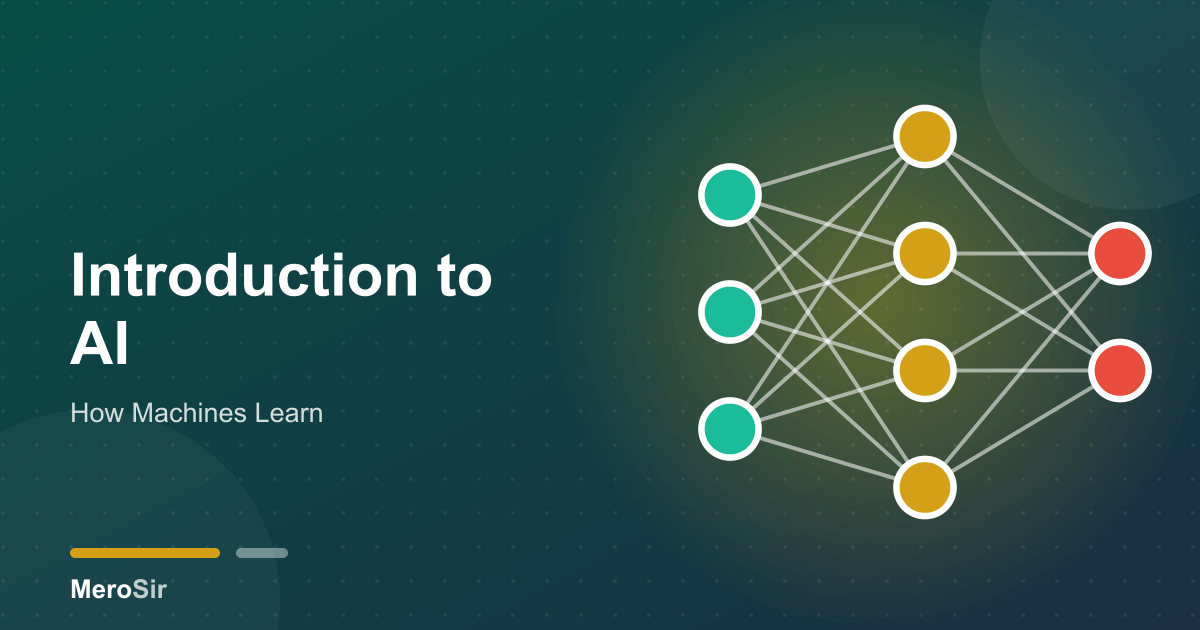
A neural network is a machine-learning model loosely inspired by the brain. It is built from many small units called neurons, arranged in layers.
One neuron
A neuron takes some numbers in, multiplies each by a weight (how important that input is), adds them up, adds a bias, and then decides whether to "fire" (output 1) or not (output 0). Learning means adjusting the weights and bias.
A neuron that learns
Here is a single neuron (a perceptron) learning the AND rule: output 1 only when both inputs are 1. Each time it is wrong, it nudges its weights in the right direction.
data = [((0, 0), 0), ((0, 1), 0), ((1, 0), 0), ((1, 1), 1)]
w1, w2, bias = 0.0, 0.0, 0.0

def predict(x1, x2):
    return 1 if w1 * x1 + w2 * x2 + bias > 0 else 0

for round_number in range(10):
    for (x1, x2), target in data:
        error = target - predict(x1, x2)
        w1 += 0.1 * error * x1
        w2 += 0.1 * error * x2
        bias += 0.1 * error

for (x1, x2), target in data:
    print(x1, x2, predict(x1, x2))
Output:
0 0 0
0 1 0
1 0 0
1 1 1
It started knowing nothing and ended up answering all four cases correctly, purely by adjusting its numbers after each mistake. That is learning.
Layers and depth
- Input layer: takes the raw data (pixels of a photo, numbers, words).
- Hidden layers: many neurons that find patterns, from simple (edges) to complex (faces).
- Output layer: gives the answer (cat or dog, a number, the next word).
Deep learning just means networks with many hidden layers. A network with millions or billions of weights needs a lot of data and computing power to train, which is why training large AI models is expensive.
Think about it
- Why does the neuron need to see the data many times (rounds)?
- What happens to the output if all weights are 0?
- Try the same code with the OR rule: output 1 if at least one input is 1.
Next lesson: chatbots and language models.
Comments
Loading comments…