When people say "I want to be a government officer", they often picture one job. In reality the civil service is a ladder with many rungs, each with a different title, responsibility, entry route and pace. Understanding that ladder is the first step to planning a government career, because it tells you where you can enter, how you can climb and what to prepare for.
Nepal's civil service structure has been under reform since federalism, with new provincial and local arrangements and updated laws. The names and levels below describe the traditional structure that most people still use; always check the latest Act and the Public Service Commission's notices for current rules.
The basics: what is the civil service?
The civil service is the permanent administrative machinery of the state. Its members run ministries, departments, offices and public services, from planning policy and managing budgets to issuing documents and delivering health or engineering services. Recruitment to permanent posts is done through the Public Service Commission, popularly called Lok Sewa Aayog, so that appointments are based on merit rather than connections.
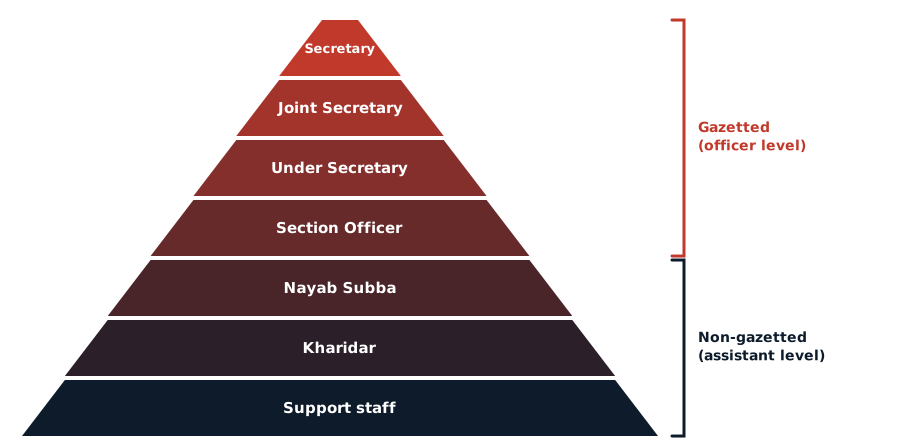
Figure: the traditional civil service ladder. Structures and names can change with new laws, so check the latest rules.
Gazetted and non-gazetted
You will hear these two words constantly:
- Gazetted posts are officer-level posts whose appointments are published in the Nepal Gazette, the government's official notice. These roles carry decision-making and supervisory responsibility.
- Non-gazetted posts are assistant-level and support posts, handling day-to-day office, technical and field work under the officers.
The traditional ladder
From the top, the traditional ranks look like this:
- Secretary (special class, gazetted) — heads a ministry or a major body, the senior-most administrative role.
- Joint Secretary (first class, gazetted) — leads a major division or wing of a ministry.
- Under Secretary (second class, gazetted) — leads a section group or smaller office and supervises several officers.
- Section Officer (third class, gazetted) — the entry point for officers; handles files, drafting, analysis and supervision of a section.
- Nayab Subba (first class, non-gazetted) — the senior assistant level.
- Kharidar (second class, non-gazetted) — the junior assistant level.
- Helper and support posts (third class, non-gazetted) — office support and similar roles.
Treat this as the general shape. Titles and levels can differ between services, and recent reforms have been reorganising levels and introducing new provincial and local structures.
Service groups: your area of work
Civil servants belong to a service and a group, which is their field. Typical services include Administration, Engineering, Health, Judicial, Education, Agriculture, Forest, Foreign Affairs and several others, each with groups and sub-groups such as general administration, civil engineering or medical roles. Your degree usually decides which services you can apply for, and the service group decides the kind of work, the promotion competition you will be in, and where you may be posted.
How people enter
- Open competition. Anyone who meets the qualification and age conditions may apply and compete through written exams and an interview. This is the main entry route at every level.
- Internal competition. Serving employees who meet requirements compete for a share of vacancies at the next level.
- Promotion. Movement up through seniority, performance evaluation, training and, in some cases, an assessment process.
Each route has its own rules: minimum education, age limits, experience, and the share of posts reserved for each route and for inclusion groups. These are published by the Commission, so always read the current notice instead of relying on what a friend heard.
What you usually need at each end
As a general pattern, officer-level posts ask for a bachelor's degree in a relevant field, while assistant-level posts ask for a lower qualification such as an intermediate or school-leaving level, depending on the post. Technical services (engineering, health, agriculture) require the relevant professional qualification and sometimes a council licence.
How the climb actually works
- You enter at a level that matches your education, usually Section Officer or assistant level.
- You complete a probation period and training, then work in your assigned office.
- Over the years you accumulate service, evaluations and training that count for promotion.
- Promotions are not automatic: positions at each higher level are fewer, so it becomes more competitive as you rise.
- Postings change. You may serve in different ministries, departments or regions, which is part of how people build wide experience.
What reforms mean for you
Federalism created provincial and local governments with their own staffing needs and their own public service commissions at the provincial level. That has created more places to apply and, over time, may change how levels and transfers between them work. If you plan to enter in the next few years, follow the new federal civil service law and your province's notices closely.
Is the civil service right for you?
- It suits you if you like structure, public service, steady growth and working through rules and process.
- It may frustrate you if you need fast change, flexible hours or private-sector style incentives.
- Be ready for competition. Many people apply for a small number of posts, and many succeed only after more than one attempt.
Ready to see where the ladder ends? Read the roadmap to becoming a Secretary, then start preparing with the Loksewa exam guide and study plan. For other job options, see types of jobs in Nepal.

Comments
Loading comments…