Every year, many thousands of people in Nepal apply for Loksewa vacancies, and a small share gets through. It is a tough exam, but it is not a mystery. People who pass are usually not geniuses; they are people who understood the syllabus, practised consistently and did not give up after a first attempt. This guide explains how the exam usually works and gives you a 90-day plan you can start this week.
Exam patterns, marks, syllabus and rules change from notice to notice and between levels and services. Treat this as a general guide, and always follow the current syllabus and notice from the Public Service Commission for the post you are applying to.
What is Loksewa?
Loksewa Aayog, the Public Service Commission, is the constitutional body that recruits people for permanent posts in the civil service and some other government bodies. There are also provincial public service commissions, and local governments have their own arrangements. The aim is merit-based selection through open competition. To see where the posts sit, read the civil service levels guide.
How the exam usually works
Patterns differ by level and service, but you will commonly meet these stages:
- The notice (vacancy announcement). It lists posts, qualifications, age limits, the application window and the fee. Read it completely.
- First phase: usually objective (MCQ). Many candidates compete for a few seats, so this stage screens out most of them. Objective papers can carry negative marking, so wild guessing hurts.
- Second phase: usually descriptive or subjective. Written answers test your understanding, structure and clarity, often including service-related papers.
- Interview, and sometimes a skill test. This checks communication, awareness and suitability. Some posts also need a practical or computer test.
- Final result and recommendation. Ranked candidates are recommended for appointment according to the number of seats.
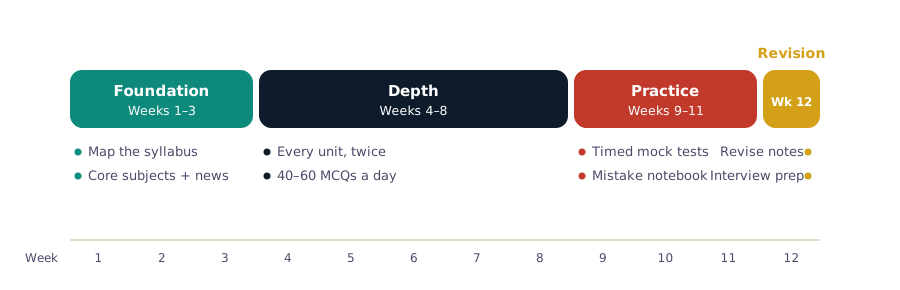
Figure: a sample 90-day plan. Stretch or shrink it to match your own time.
What you study
The Commission publishes a syllabus for every level and service. It is the single most important document in your preparation. Most syllabi include some or all of these areas:
- General knowledge: Nepal's geography, history, culture, society and economy.
- Constitution and governance: the structure of the state, rights and duties, federal arrangements, key institutions.
- Current affairs: national and international events, development plans and budgets.
- Public administration and management: basics of how government works.
- Mental ability and reasoning: logic, numerical and verbal reasoning.
- Language: Nepali and English, usually grammar, comprehension and writing.
- Service-related subjects: subjects specific to your service, such as health, engineering or administration.
Before you start: three decisions
- Pick one post and level. You cannot prepare well for everything at once.
- Download and read the syllabus. Mark every topic as strong, medium or weak.
- Decide your study hours. Most people can do a few focused hours a day around work or college. Consistency matters more than heroic days.
The 90-day plan
This plan has four phases. Adapt the topics to your syllabus; keep the rhythm.
Phase 1 — Foundation (Weeks 1–3)
- Map the syllabus: list every unit and rate yourself.
- Collect a small, trusted set of materials: one good book or notes per major subject, the syllabus and previous questions. Resist hoarding ten books per subject.
- Start the core subjects: constitution and governance, Nepal general knowledge, and basics of public administration.
- Begin a daily current affairs habit: 20 minutes of reading, with short notes.
- Do 20 to 30 MCQs a day, mainly to get a feel for the style.
Phase 2 — Depth (Weeks 4–8)
- Cover every unit once with notes, then move to a second, faster pass.
- Add reasoning and language practice: a short daily set, reviewed carefully.
- Study service-related subjects in depth.
- Raise daily MCQs to 40 to 60 and always read the explanation for the ones you missed.
- Start answer writing once a week for the descriptive phase: pick a question, write within a time limit, compare with a model answer.
Phase 3 — Practice (Weeks 9–11)
- Solve previous questions in sets and under timed conditions.
- Take full mock tests, at least two a week, and analyse every wrong answer: was it knowledge, speed or carelessness?
- Keep a "mistake notebook" of facts you keep missing and revise it daily.
- Continue weekly answer writing and polish your structure and handwriting.
Phase 4 — Revision and calm (Week 12)
- Revise from your own notes and mistake notebook only; do not start new books.
- Do light mixed practice, rest well and keep a steady sleep schedule.
- Prepare for the interview: your own background, why you want the service, current affairs and basic governance questions.
A sample daily schedule (about 4 hours)
- 45 min — new topic from the syllabus
- 45 min — revision of yesterday's topic and notes
- 20 min — current affairs
- 60 min — MCQ practice with explanations
- 30 min — language or reasoning
- 20 min — mistake notebook and planning tomorrow
If you can only study two hours, keep the same order of importance: new topic, revision, MCQs.
Mistakes that quietly cost marks
- Studying without the syllabus. Time spent on topics that never appear is time lost.
- Collecting instead of studying. More books are not progress.
- No revision. You forget most of what you read once, so a plan without revision is half a plan.
- Ignoring current affairs until the last week.
- Never practising under time pressure. Speed is a skill.
- Guessing blindly where negative marking exists.
- Neglecting health and sleep. A tired mind forgets and panics.
Keep your mindset steady
Many selected candidates passed on their second or later attempt. A failed attempt is data: you now know the exam's style, your weak topics and your pace. Learn from your marks, adjust your plan and try again with a clearer strategy.
Practise with MeroSir
Daily MCQ practice is the heart of Phase 2 and 3. On MeroSir you can browse free Loksewa-style MCQs, take timed tests, flag questions to revise later and see explanations. Try Time Pass for endless practice with a score summary at the end, or sit a full test when you are ready. Learn more about the career you are aiming for in the roadmap to becoming a Secretary, and see other job types if you want a backup plan.

Comments
Loading comments…