Nepal's history is long, and it is easier to understand when you see it first as a few big chapters instead of hundreds of separate dates. This is the opening chapter of our guide to Nepal's history. It gives you the whole map in one page, so every later chapter has a place to sit.
Dates in this guide are approximate where historians disagree, and they are written as "around" when we are not fully certain. Years appear in both the Gregorian calendar (AD) and Bikram Sambat (BS) where the BS year is commonly used in exams. Always check your official syllabus and a trusted textbook for the exact date you need.
The big picture: eight periods
- Ancient Nepal — early dynasties such as the Gopals, Mahispals and the Kirats in the Kathmandu valley, and the birth of the Buddha at Lumbini. Much of this comes from tradition and chronicles, so details are less certain.
- The Lichchhavi period — the first well-documented age, with stone inscriptions beginning around the 5th century AD. It is often called a golden age of art and trade.
- The medieval period — the Thakuri dynasties and then the Malla kings, who ruled the Kathmandu valley's city-states and built many of its famous squares and temples. In the west, the Khas Malla kingdom and many small principalities flourished.
- Unification — in the 18th century, Prithvi Narayan Shah's Gorkha kingdom conquered the valley and many hill states, creating the Nepal we know today.
- Expansion, war and the Sugauli treaty — the kingdom grew rapidly, fought the British East India Company in 1814–1816, and lost a large part of its territory.
- Court intrigue and the Rana regime — after years of power struggles, Jung Bahadur seized power in 1846, and the Rana family ruled as hereditary prime ministers until 1951.
- Democracy, the Panchayat and the 1990 movement — the end of Rana rule in 1950–51, a short experiment with parties, then the party-less Panchayat system from 1960 until 1990.
- Conflict, republic and federalism — the armed conflict from 1996, the 2006 movement, the end of the monarchy in 2008 and the constitution of 2015.
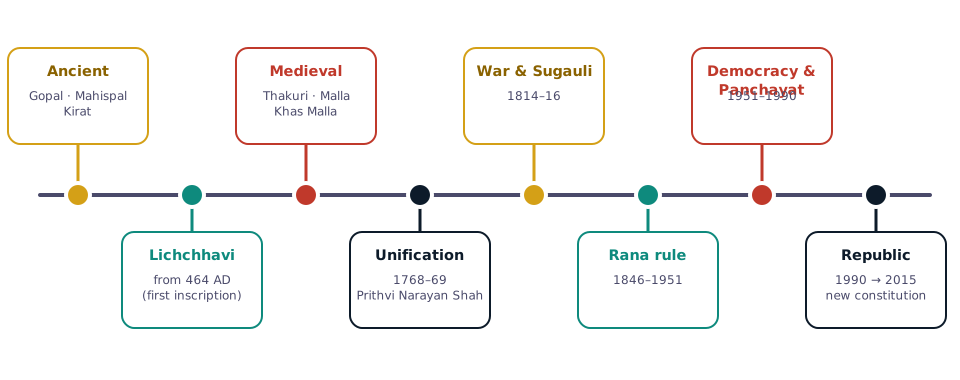
Figure: Nepal's history in eight broad periods. Dates are approximate for the early periods.
A very short timeline
- Around the 6th century BC — traditional period for the Buddha's birth at Lumbini.
- 464 AD — the earliest dated Lichchhavi inscription (King Manadeva, Changu Narayan).
- Around 879 AD — the traditional start of Nepal Sambat.
- Around the 14th century — Jayasthiti Malla's reforms in the Kathmandu valley.
- 1768–69 — Prithvi Narayan Shah conquers the three valley kingdoms.
- 1814–1816 — Anglo-Nepal War and the Treaty of Sugauli.
- 1846 — Kot Parva and the rise of Jung Bahadur Rana.
- 1951 (2007 BS) — the end of Rana rule.
- 1960 (2017 BS) — King Mahendra ends the multiparty system.
- 1990 (2046/47 BS) — the people's movement restores multiparty democracy.
- 2006 (2062/63 BS) — the second people's movement.
- 2008 (2065 BS) — the monarchy is abolished and Nepal becomes a republic.
- 2015 (2072 BS) — the constitution is promulgated.
How to study history without drowning in dates
- Learn the periods in order first. If you know the eight periods above, every date has a home.
- Attach each period to people and places. Lichchhavi — Manadeva and Amshuvarma; Malla — Jayasthiti and Pratap Malla; unification — Prithvi Narayan Shah.
- Ask "why" for each turning point. Why did unification succeed? Why did the war with the British end in a treaty? Cause and effect is easier to remember than a bare date.
- Make a one-page timeline in your own handwriting and revise it every week.
- Practise questions. Short MCQs on history are the quickest way to find what you forget.
What exams usually ask
Loksewa, teaching-licence and other competitive exams usually test names, dates, treaties, reforms, and the order of events. They like questions such as "Who was the first king of a dynasty?", "Which treaty ended the Anglo-Nepal War?" and "Which year did Rana rule end?". The chapters ahead highlight these facts in each section.
Where to go next
Start with the first chapter: Ancient Nepal — the Gopals, Mahispals and Kirats. After that, the story moves through the Lichchhavi period and into the medieval age.
Comments
Loading comments…