Ask five people in Nepal how the education system works and you will probably get five slightly different answers. Part of the reason is that the system has changed a lot in the last decade: the old SLC became SEE, Class 11 and 12 moved around, and schools came under local governments after federalism. This guide puts the whole ladder in one place, in plain language, so you can see where you are and where each path can go.
A quick note before we start: names of exams, rules and numbers change from time to time. Treat this as a map, and always confirm the latest details with the official body or your school.
The big picture
If you strip away the details, school and university education in Nepal looks like a ladder with a few side doors:
- Early childhood development (ECD) — nursery and pre-primary years before Class 1.
- Basic education — Classes 1 to 8.
- Secondary education — Classes 9 to 12, with a national exam (SEE) at the end of Class 10 and another at the end of Class 12.
- Higher education — bachelor's, master's, MPhil and PhD at universities and their colleges.
- Technical and vocational education — a parallel route of short courses, diplomas and skill training.
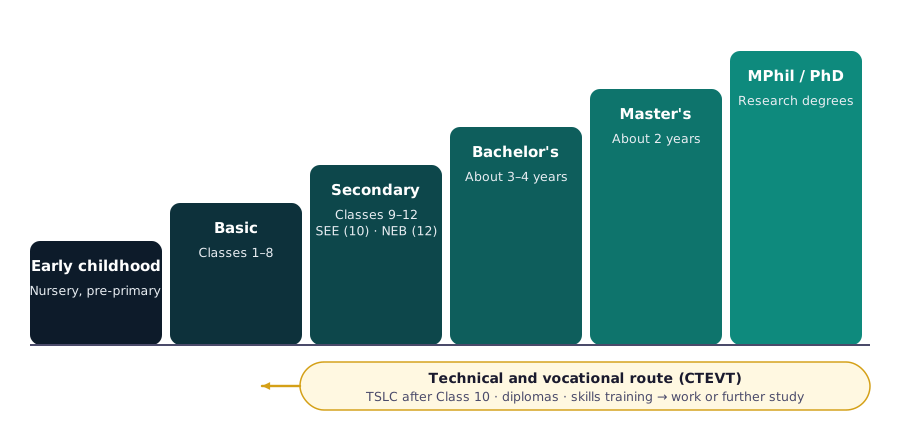
Figure: the education ladder, from early childhood to research degrees, with the technical route alongside.
Early childhood and basic education (Classes 1–8)
Most children start with a year or two of early childhood education and enter Class 1 at around five or six years old. Basic education runs through Class 8 and is the stage the state treats as compulsory and free in public schools. Classes 1 to 5 are usually called primary and Classes 6 to 8 lower secondary.
Since federalism, local governments (municipalities and rural municipalities) are responsible for running school education up to the secondary level. That is why you may now see a Class 8 examination managed locally, and why the quality and facilities of public schools can differ a lot from one municipality to another.
Schools are broadly of two kinds. Community (public) schools are funded by the government. Institutional (private) schools charge fees. Many institutional schools teach in English, while community schools have traditionally used Nepali, though more public schools now offer English-medium sections too.
Secondary education and the SEE (Classes 9–10)
Classes 9 and 10 make up the lower part of secondary school, and the national exam at the end of Class 10 is the Secondary Education Examination (SEE). For many years this was the School Leaving Certificate, the famous "SLC", often called the iron gate because of its pass-or-fail pressure. SEE replaced it a few years ago and moved to letter grades and a grade point average (GPA) instead of simple division marks.
The practical effect: you will see results like "A", "B+" or a GPA such as 3.6 on a SEE certificate, and many colleges look at your grades in specific subjects (for example Science and Maths for a science stream) when they decide admissions.
Classes 11 and 12 (+2) and the NEB
After SEE, most students go on to Classes 11 and 12, commonly called +2 or the intermediate level. These years are overseen by the National Examinations Board (NEB), which sets the curriculum framework and conducts the board exam at the end of Class 12.
The common streams are Science, Management, Humanities and Education, and there are others such as Law and Hotel Management in some schools. Your stream matters because it opens (and sometimes narrows) your options later. For example, medical and engineering entrance exams normally expect a science background. We look at this choice in more detail in our guide on which stream to choose after SEE.
The technical and vocational route
Not everyone follows the school-to-university road, and that is perfectly fine. The Council for Technical Education and Vocational Training (CTEVT) and its affiliated institutions offer short courses, the technical school leaving certificate (TSLC) after Class 10, and diploma programmes in areas such as engineering, health, agriculture and hospitality. These can lead straight to work, or to further study, depending on the course.
Higher education: bachelor's to PhD
Higher education is delivered by universities and the colleges affiliated to them. A few key points:
- Bachelor's degrees usually take around three to four years, while some professional programmes such as engineering and medicine take longer.
- Master's degrees typically take around two years after a bachelor's.
- MPhil and PhD programmes are research degrees for those who want to teach at university level or work in research.
- Programmes are run on either an annual or a semester system, depending on the university and faculty.
Nepal has several universities, public and private, and many of them also run constituent campuses of their own. We cover how to compare them in universities and colleges in Nepal.
Who runs what?
One reason the system feels confusing is that several bodies each look after a piece of it:
- The Ministry of Education sets national policy.
- The Curriculum Development Centre prepares school curricula and textbooks.
- The National Examinations Board handles the Class 11–12 board exams (and standards for the national exams).
- The University Grants Commission (UGC) supports and monitors universities.
- CTEVT looks after technical and vocational education.
- The Teacher Service Commission recruits teachers for public schools.
- Local governments manage school education in their area.
There is a fuller breakdown in education boards and regulators in Nepal.
Practical tips for students and parents
- Keep your documents safe. SEE and +2 certificates, transcripts, character certificate and citizenship papers are asked for again and again.
- Choose a stream by interest and ability, not only by what friends or relatives are choosing. A stream you enjoy is easier to finish with good grades.
- Check that a college and programme are properly affiliated and recognised before paying fees. Ask for the affiliation in writing.
- Plan early for entrance exams. Many programmes (medicine, engineering, some management courses) have their own entrance tests with fixed seats.
- If you may study abroad, ask the institution you are applying to what documents and equivalence they expect.
Where to go next
Once you understand the ladder, the next questions are usually about choices: which stream, which course, which college, and which career it leads to. Those are exactly the topics we cover in this blog, and you can practise the exams that sit on top of the system with free MCQ tests on MeroSir.
Comments
Loading comments…