
Two decisions shape a lot of a young person's future in Nepal: the stream you pick after SEE and the course you pick after +2. Both are usually made at an age when nobody has much information, plenty of people around have opinions, and the pressure to "choose something good" is heavy. This guide will not tell you what to pick. It gives you a way to think it through, and a clear picture of where each path commonly leads.
Admission rules, entrance exams and seat numbers change from year to year. Treat the paths below as general patterns and verify the current requirements for any programme you are serious about.
Part 1: Choosing a stream after SEE
Start with yourself, not the stream
Before you look at streams, spend an honest evening on three questions:
- What do I actually enjoy? Not what sounds impressive, but what you would read about for fun.
- What am I good at? Look at your SEE subject grades, but also at the things teachers and friends say you pick up quickly.
- What can I realistically afford? Some paths mean years of fees, coaching and living away from home.
The common streams
- Science. Physics, Chemistry and Biology or Mathematics (and sometimes Computer Science). It keeps medicine, engineering, IT, agriculture and pure science open, but it is demanding and the entrance exams afterwards are competitive.
- Management. Accountancy, Economics, Business Studies and related subjects. It leads towards business, banking, accounting, finance, hospitality and administration, and combines well with professional courses such as chartered accountancy.
- Humanities. Subjects such as Sociology, Population, Rural Development, Political Science, Mass Communication and Languages. It leads to law, social work, journalism, public administration, teaching, research and civil service preparation.
- Education. Aimed at those who want to become teachers; it connects to education degrees and the teaching licence route.
- Technical and vocational (diploma/TSLC). A shorter, skills-first route in engineering, health, agriculture, hospitality and more. Good for those who want to start working earlier or step into a profession quickly.
Subject combinations and the names of programmes differ between schools, so ask what exactly each school offers before you choose.
A simple way to decide
- Write down two or three careers that interest you, however vague.
- For each, find out what qualification and entrance route it needs. Often the stream is the first filter.
- Talk to two people actually doing that job, and one student a year or two ahead of you.
- Pick the stream that keeps the most of your preferred doors open without forcing you into subjects you dislike.
And a gentle warning: please do not choose a stream only because friends are choosing it, or only because a relative says it "has scope". Almost every stream has scope for people who are good and committed.
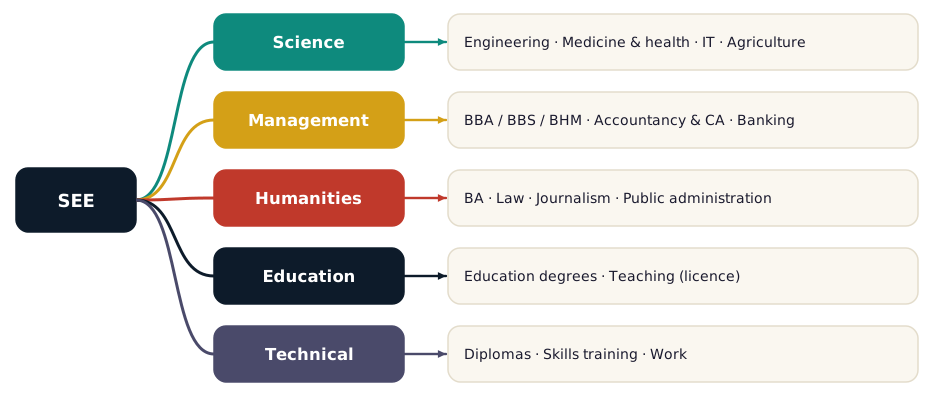
Figure: where each stream after SEE can lead. These are examples, not the only options.
Part 2: Choosing a course after +2
This is where the stream you chose starts to show its range. Here are the paths that commonly follow each one.
After Science
- Engineering (civil, computer, electrical, electronics, architecture and more), usually through an entrance exam.
- Medicine and health sciences (MBBS, BDS, nursing, pharmacy, public health, medical laboratory and others), often with competitive entrance and licensing requirements.
- IT and computing such as BSc CSIT, BCA or BIT.
- Agriculture, forestry and veterinary science.
- BSc in basic sciences, which can lead to research, teaching or further study.
After Management
- BBA, BBS, BBM, BIM, BHM and similar business and hospitality degrees.
- Chartered accountancy and other professional accounting tracks.
- Banking, insurance and finance careers, often starting with a bachelor's and building from there.
After Humanities
- BA in subjects that suit your interest, as a base for a master's or civil service preparation.
- Law, social work, journalism and mass communication, public administration and development studies.
After Education
- Education degrees leading to teaching, plus the teaching licence process.
- Other bachelor's programmes open to education graduates, depending on admission rules.
After a diploma or TSLC
- Start working in your skill area, or continue to higher diploma and bachelor's programmes where bridging options exist.
How to compare two courses you like
- Duration and total cost — including fees, coaching and living costs.
- Entrance and licence requirements — does it need a competitive exam, a licence or both?
- What the first job looks like — ask graduates what they do and earn in the first two or three years, roughly.
- Room to change direction — will this degree still be useful if you change your mind later?
- Your own motivation — you will spend years on this; interest matters more than prestige.
If you already chose and it feels wrong
It happens, and it is not the end of the road. Many people switch with a bridge course, move into an adjacent field, or build skills (languages, computing, communication) that carry across fields. Finish what you started to a reasonable level while you explore, rather than quitting in a panic.
For the bigger picture, read how Nepal's education system works, and once you have a short list of courses, use our checklist for choosing a college. If government service interests you, see the roadmap to the top of the civil service.
Comments
Loading comments…