Japanese looks hard from the outside, but it has a big advantage for Nepali learners: the sentence is built almost the same way as in Nepali. Before you learn the characters, this lesson gives you the map, so everything that follows makes sense.
Three scripts, used together
Japanese is written with three sets of characters in the same sentence:
- Hiragana (ひらがな): 46 round characters. Each one is a sound. It is used for grammar words and endings, and it is the first thing you learn. Every Japanese word can be written in it.
- Katakana (カタカナ): 46 angular characters for the same sounds. It is used for foreign words (コーヒー, coffee), foreign names, and for emphasis. You will also use it to write your own name.
- Kanji (漢字): characters from Chinese. Each one carries a meaning (日 = sun, day). It is used for the main part of most words. There are thousands, but you start with a small, useful set.
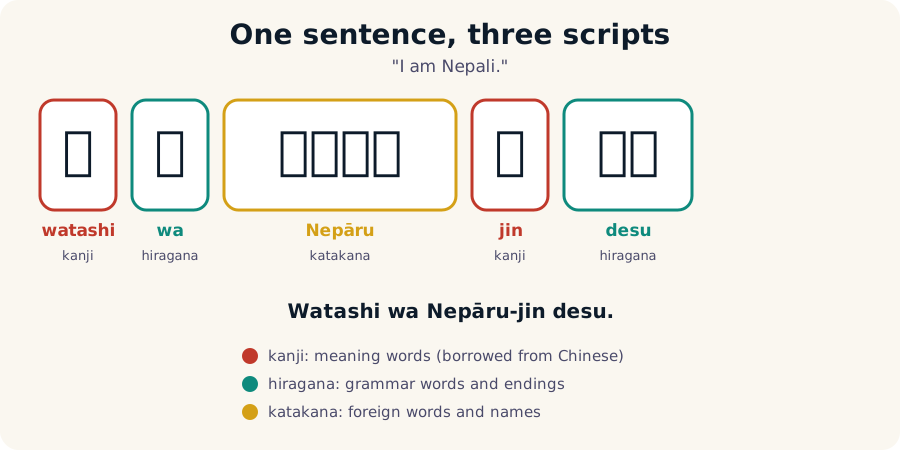
The same sentence uses all three scripts. You can read hiragana and katakana after Parts 2 and 3.
There is also romaji: Japanese written in English letters (arigatou). In this course romaji is a helper in the first lessons. The goal is to stop needing it, because romaji hides the real sounds and Japanese people do not use it for reading.
Learning order: hiragana first, then katakana, then kanji bit by bit. Kana (hiragana and katakana together) are only 92 characters and can be learned in a few weeks of daily practice.
Word order: the verb comes last, as in Nepali
English says I eat rice (subject, verb, object). Nepali says म भात खान्छु (subject, object, verb). Japanese does the same as Nepali:
| Subject | Object | Verb | |
|---|---|---|---|
| Nepali | म | भात | खान्छु |
| Japanese | わたし は (watashi wa) | ごはん を (gohan o) | たべます (tabemasu) |
| Word by word | I | rice | eat |
Listen: わたしは ごはんを たべます。 ▶ (watashi wa gohan o tabemasu: नेपाली: म भात खान्छु। English: I eat rice.)
Because the verb is always at the end, you often have to wait for the end of a Japanese sentence to learn if it is a question, a negative or a past event. Learners must listen to the whole sentence. Nepali speakers already do this.
Particles: small words after the noun
Japanese marks the job of each word with a small particle that comes after it, just like Nepali postpositions (मा, लाई, बाट). You will meet them one by one:
| Japanese | Romaji | नेपाली | English | Listen |
|---|---|---|---|---|
| は | wa | विषय बताउने (…को बारेमा भन्दा) | marks the topic: "as for…" (written は, read wa) | ▶ |
| を | o | कर्म बताउने (भात खान्छु) | marks the object of a verb (written を, read o) | ▶ |
| に / で / へ | ni / de / e | मा / मा, बाट / तिर | place, time, direction (へ is read e) | ▶ |
| か | ka | प्रश्न चिह्न | put at the end of a sentence to make it a question | ▶ |
A question is just the sentence plus か: ネパールじんですか。 ▶ (nepaaru-jin desu ka: नेपाली: नेपाली हुनुहुन्छ? English: Are you Nepali?). There is no change in word order, and you do not need to learn do/does.
What Japanese does not have
- No genders and no articles (no a/the).
- No plural endings in everyday words: ほん (hon) means book or books; context and numbers tell you how many.
- No tones, unlike Chinese. Japanese has a gentle pitch accent, covered briefly in Lesson 2.
- The subject is often left out, as in Nepali (भात खान्छु does not say म). You say who only when it is not clear.
Politeness levels: like तँ, तिमी, तपाईं
Nepali changes verbs by respect (खा, खाऊ, खानुहोस्). Japanese has a similar idea. This course teaches the polite form (です, ます). It is correct with teachers, bosses, shopkeepers and strangers, and it is what the JFT-Basic and JLPT tests use. The casual form used with close friends comes later.
| Japanese | Romaji | नेपाली | English | Listen |
|---|---|---|---|---|
| です | desu | हो / छ (आदरपूर्वक) | polite "is / am / are" | ▶ |
| ます | masu | क्रियाको आदरपूर्वक अन्त्य | polite verb ending (たべます = eat) | ▶ |
How to write and read
- Modern books and websites are written left to right, top to bottom, like English and Nepali. Newspapers and novels often use vertical lines, read from right to left.
- Japanese has no spaces between words. Beginner books add spaces, and so does this course in kana-only sentences, to help you see the words.
- Punctuation: 。 (maru) is the full stop and 、 (ten) is the comma.
How this course works
- Each lesson ends with Check yourself questions and Answers. Cover the answers and try first.
- Every Japanese word has the romaji, the Nepali meaning and the English meaning. Press ▶ to hear it.
- Hiragana and katakana lessons include stroke order sheets. Write with a pencil and say each sound aloud as you write.
- The audio is in two voices: a woman and a man.
Every ▶ button plays a clear computer voice, which is good for learning sounds and rhythm but is not a native speaker. Pitch (the rise and fall of the voice) can sound a little flat. Also listen to real Japanese as often as you can: videos, news for learners (NHK Easy), and Japanese people around you.
Check yourself
Try to answer every question before you look at the answers.
- Name the three scripts used to write Japanese.
- Which script do you learn first, and why?
- What is katakana mainly used for?
- What does a kanji carry that a kana does not?
- In the sentence わたしは ごはんを たべます, which word is the verb, and where does it sit?
- Which Nepali sentence has the same word order as わたしは ごはんを たべます?
- What do you add to the end of a sentence to make it a question?
- The particle は is written は. How is it read when it is a particle?
- Does Japanese have articles (a, the) or gender for nouns?
- Which politeness form does this course teach first, and who is it right for?
Answers
Count your correct answers. If you got fewer than 7 out of 10, read the lesson again and listen to the audio once more.
- Hiragana, katakana and kanji.
- Hiragana. Every word can be written in it, and it is used for grammar words and endings.
- Foreign words and names (such as コーヒー and ネパール), and for emphasis.
- A meaning (for example 日 means sun or day). A kana only carries a sound.
- たべます (eat). It is the last word, as in Nepali.
- म भात खान्छु (subject, object, verb).
- か.
- wa (not ha).
- No.
- The polite です/ます form, right for teachers, bosses, shop staff and strangers.
Comments
Loading comments…